
01
Audit Overview
Your store's untapped revenue potential — and how to unlock it
Why We Created This Audit
We analyzed beautyprophet.com the same way we've audited 350+ e-commerce stores — looking for the specific gaps between your current experience and what top-performing Beauty & Personal Care stores deliver. Every finding in this report is a revenue opportunity backed by industry data and competitive benchmarks.
3 Critical
8 Important
3 Opportunities
What We Analyzed
- UX & Conversion Design14 findings
- Technology & App StackPlatform + 4 apps
- Industry BenchmarksBeauty & Personal Care
Pages Analyzed
- Homepage3 findings
- Collection Pages2 findings
- Product Pages (PDP)6 findings
- Cart & Checkout3 findings
 This audit was prepared by Growisto — a CRO-led Website development team behind 167% conversion growth for Atomberg, 46% CR lift for TyresNmore, and 350+ e-commerce projects.
02
UX & Conversion Findings
Page-by-page analysis with visual comparisons against top Beauty & Personal Care stores
No email capture mechanism — missing the #1 returning visitor conversion channel
Feature not present
Beauty Prophet — Feature Not Present
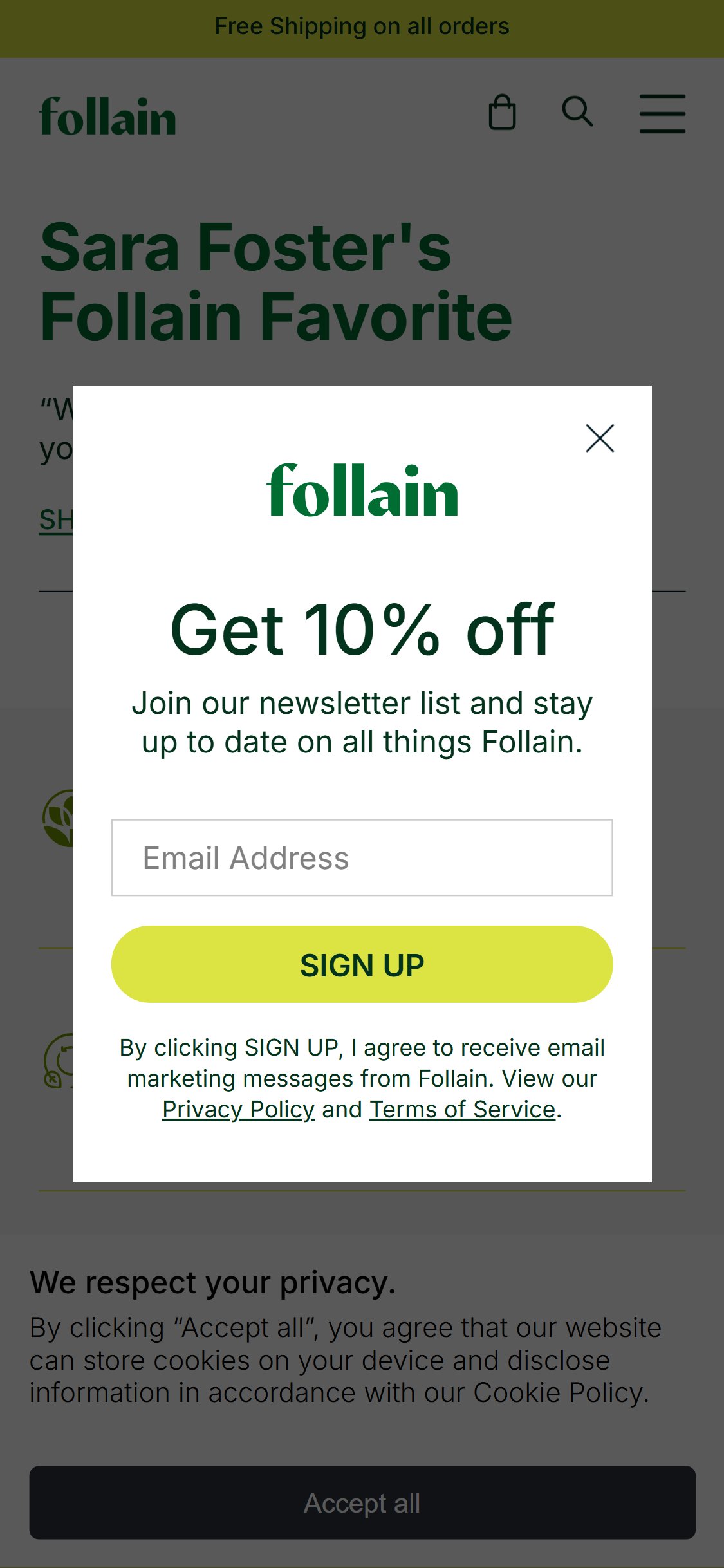
Follain — Inline Newsletter Signup with First-Access Offer
Observations
- Beauty Prophet has no email popup, no inline signup form, and no exit-intent capture visible anywhere on the site — homepage, PDPs, or collection pages.
- A footer 'Earn Rewards' link and skin quiz exist, but neither actively captures email addresses from first-time visitors who browse without purchasing.
- Email marketing drives 20-35% of revenue for D2C beauty brands — without an email list, Beauty Prophet cannot retarget the majority of visitors who leave without buying.
- Competitors like The Detox Market and Follain use Klaviyo-powered popups offering first-order discounts (typically 10-15% off) to convert anonymous traffic into identifiable subscribers.
Recommendations
- Implement a Klaviyo popup triggered after 10-15 seconds or on exit intent, offering a first-order incentive (10-15% off, or a free sample upgrade) in exchange for email signup.
- Test a skin quiz as the email capture mechanism ('Take our skin quiz to find your perfect routine') — this performs well for curated beauty retailers and aligns with Beauty Prophet's skin quiz in the footer.
- Place a persistent inline signup section on the homepage mid-scroll for visitors who dismiss the popup — second-chance capture that doesn't rely on the popup alone.
Homepage product cards lack star ratings — 100% of beauty benchmarks show ratings on cards
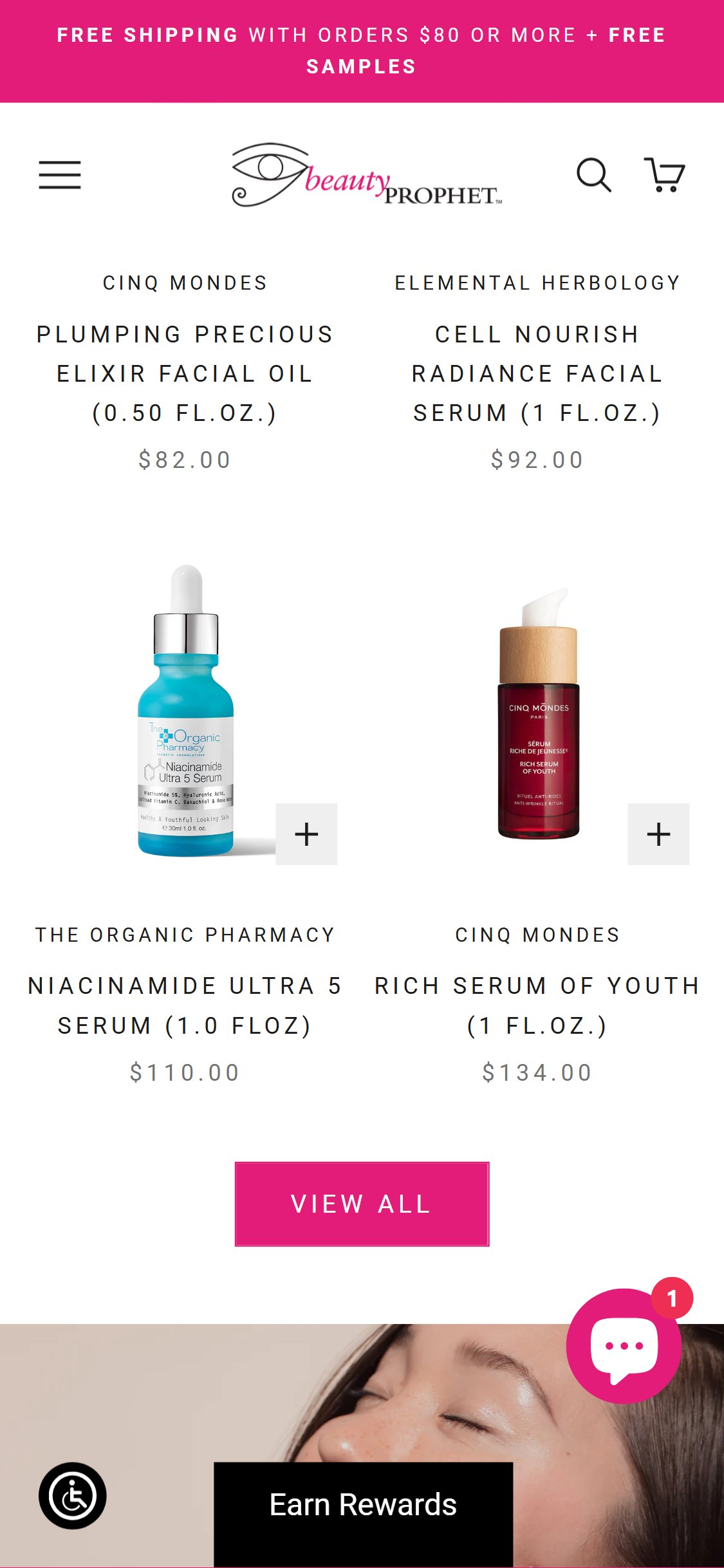
Beauty Prophet — Product Cards Without Ratings

Proposed Implementation — Product Cards with Star Ratings
Observations
- The homepage 'Best Beauty for You' product sections show product images, names, and prices — but no star ratings or review counts appear on any product card.
- While the collection page (/collections/all) shows minimal review counts (0-1 reviews per product), the homepage product sections display no social proof whatsoever.
- Every benchmark beauty brand (Kiehl's, Fenty, Glossier, The Ordinary) displays star ratings on homepage featured product cards — shoppers use ratings to quickly evaluate which products are worth clicking through to.
- For a curated multi-brand store where brands like Cinq Mondes may be unknown to US shoppers, product-level ratings are the fastest trust signal for driving card-to-PDP clicks.
Recommendations
- Enable star rating display on all homepage product cards — this typically requires activating the review widget's 'product card' snippet in the theme.
- Prioritize displaying ratings on products with >5 reviews first; for products with 0 reviews, show 'Be the first to review' as a social engagement CTA.
- Feature 3-5 'top-rated' products as a dedicated homepage section ('Most Loved by Our Community') to leverage existing reviews as a conversion driver.
Single-message announcement bar misses 3x value — rotating bars drive higher engagement
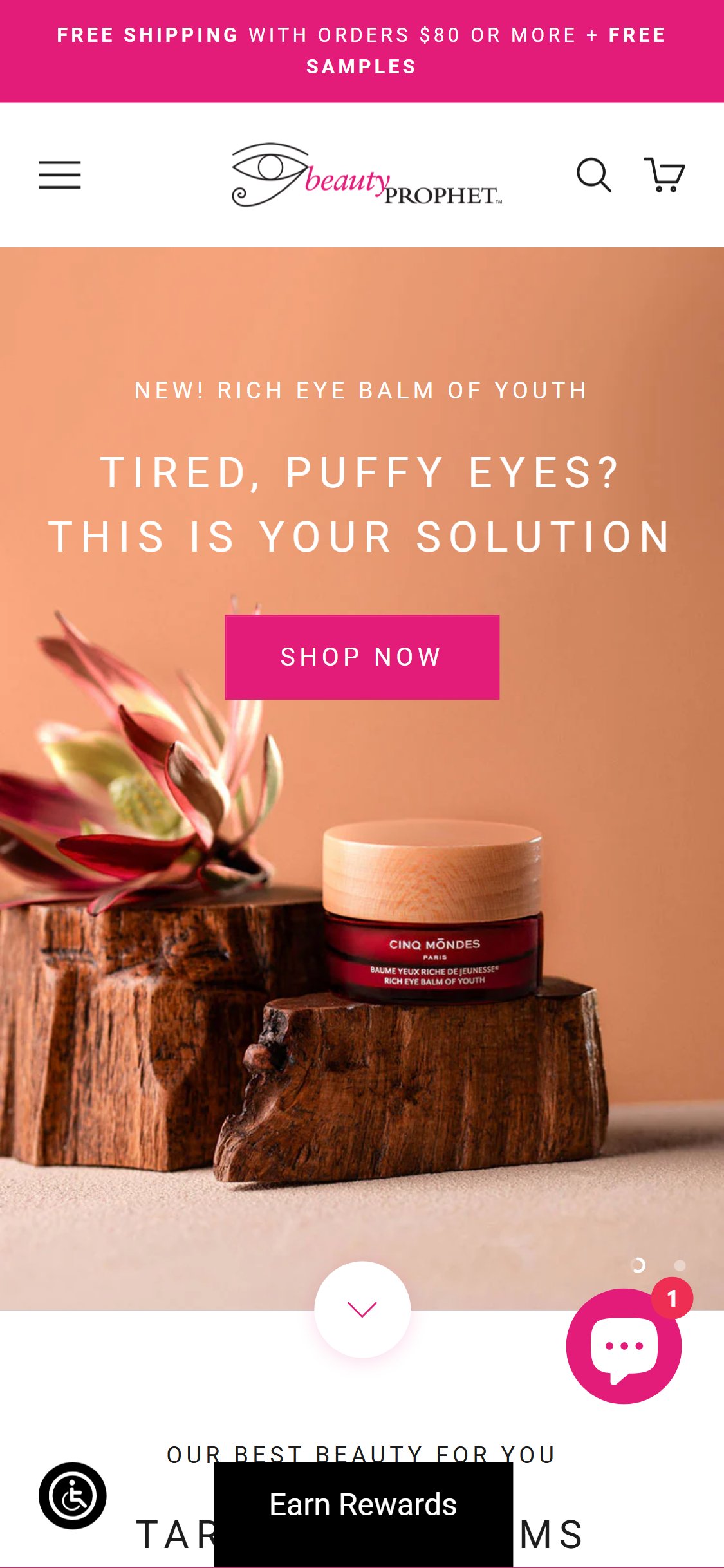
Beauty Prophet — Static Single-Message Bar

Proposed Implementation — Rotating 4-Message Announcement Bar
Observations
- Beauty Prophet's announcement bar shows only one static message: 'FREE SHIPPING WITH ORDERS $80 OR MORE + FREE SAMPLES' — no rotation, no promotional variety.
- A static bar wastes the only above-fold real estate that reaches 100% of visitors on every page load — other promotional messages (new arrivals, brand partnerships, skin quiz) compete for homepage hero space instead.
- 9/10 beauty benchmark brands (Kiehl's is the gold standard with 4 rotating messages) use announcement bars with 3-4 rotating messages: free shipping threshold, current promotion, brand news, and a loyalty/rewards callout.
- The $80 free shipping threshold is relatively high for a beauty retailer — a static bar doesn't allow Beauty Prophet to also communicate '4 Free Samples with Every Order' or 'New: Cinq Mondes Paris Collection' which are stronger hooks for new visitors.
Recommendations
- Add 3-4 rotating messages to the announcement bar: (1) Free shipping threshold, (2) 'Up to 4 free samples with every order', (3) Current promotion or new brand arrival, (4) Skin quiz CTA or loyalty points mention.
- Set rotation interval to 4-5 seconds with smooth fade transition — too fast (1-2 sec) is disorienting, too slow (8+ sec) wastes the bar.
- A/B test reducing the free shipping threshold ($60 or $70) and use the bar rotation to test which messaging drives the most homepage-to-collection click-through.
Minimal collection filters prevent concern-based discovery across 152 products
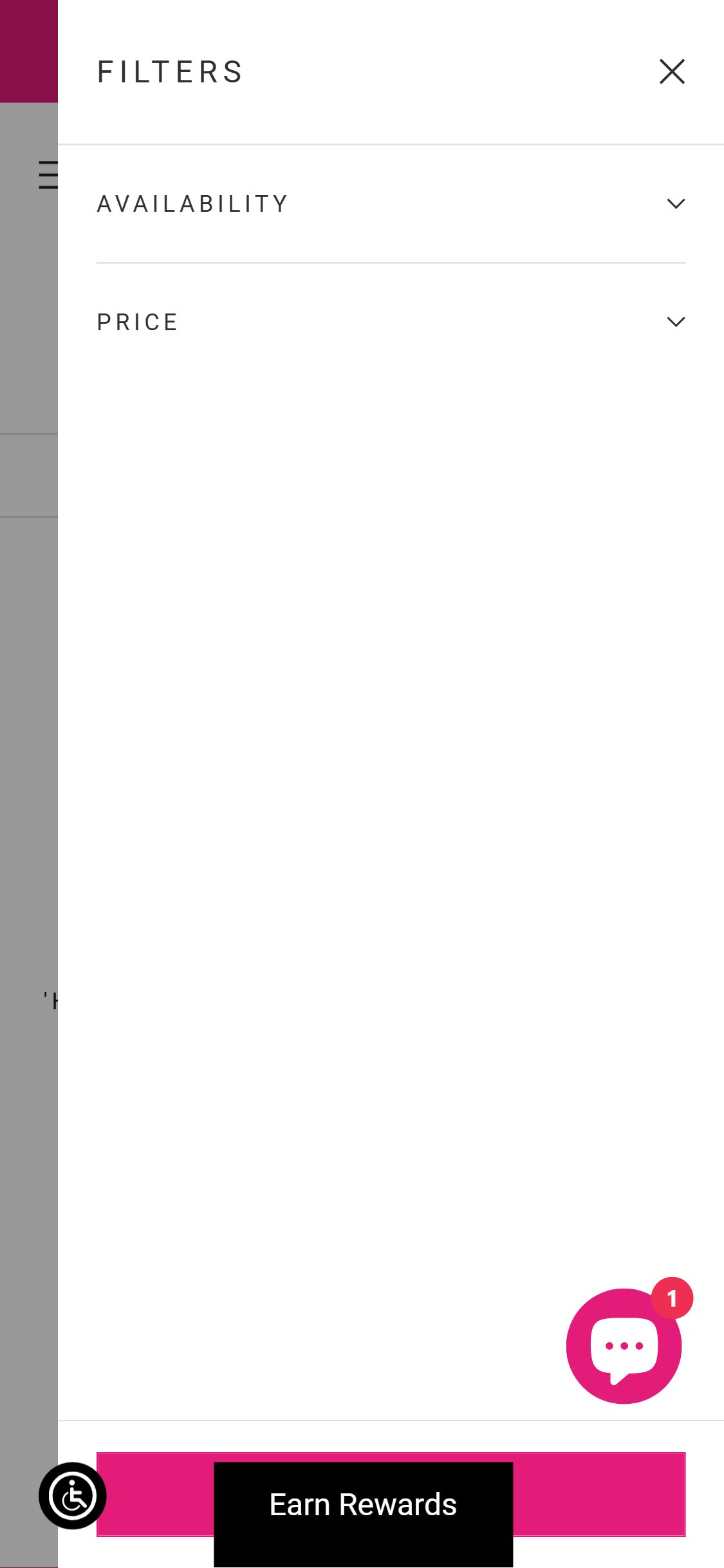
Beauty Prophet — Only 2 Filter Options
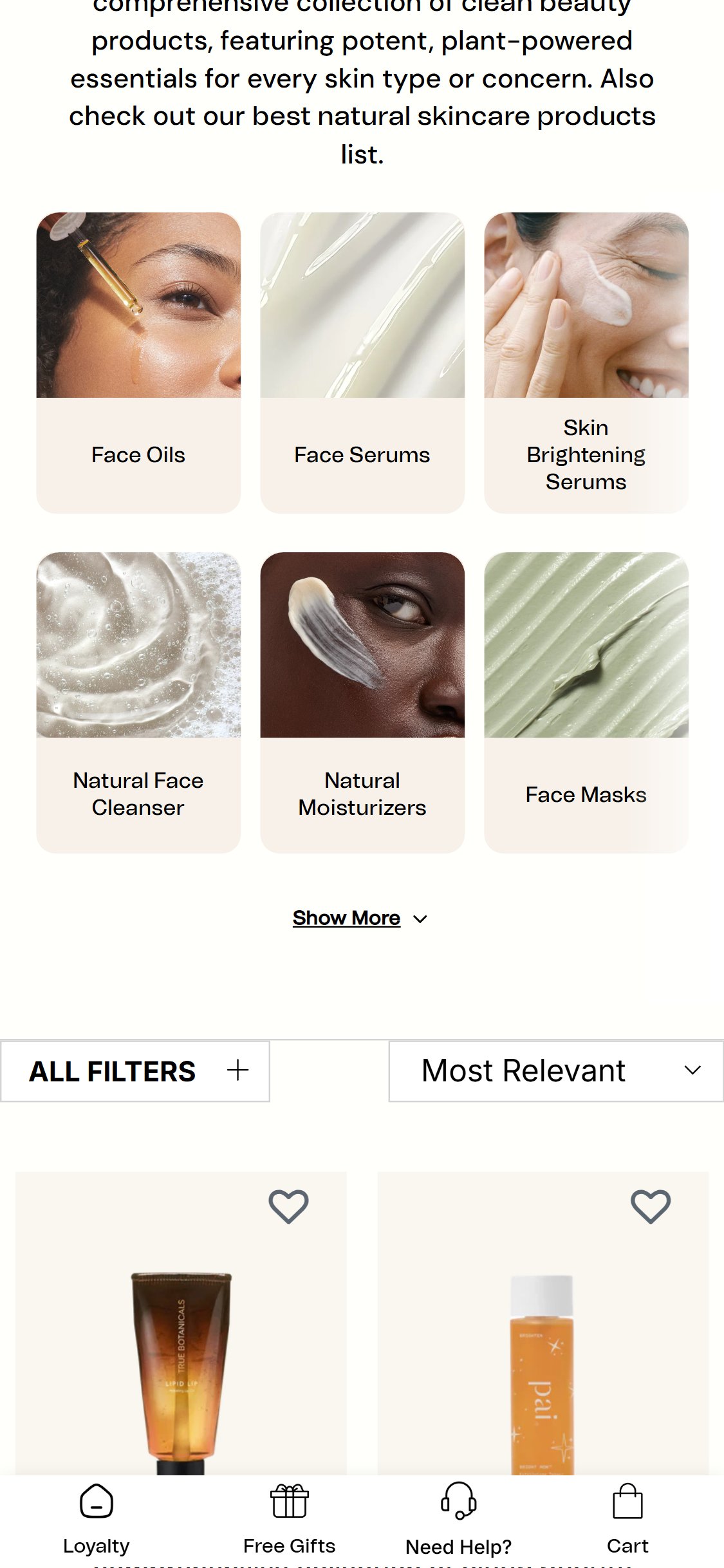
The Detox Market — Robust Filters: Product Type, Brand, Price
Observations
- The collection filter panel shows only 'Availability (In stock)' and 'Price range' — missing the skin concern, ingredient, and brand filters that are fundamental to beauty product discovery.
- Beauty Prophet's navigation is organized by skin concern (Acne, Dry, Aging) and ingredient (Vitamin C, Hyaluronic Acid) — but these same dimensions are not available as collection filters, creating a disconnect between browsing intent and filter capability.
- With 152 products across 7 pages and no concern/ingredient filtering, shoppers seeking a 'Vitamin C serum for dry skin' must either use the navigation menu OR manually browse 7 pages — a friction-heavy discovery experience.
- 8/10 beauty benchmark brands offer at least 4 filter categories: product type, skin concern, key ingredient, and price range — enabling shoppers to self-qualify products against their skin needs.
Recommendations
- Add skin concern filters (Acne/Blemishes, Dry/Dehydrated, Aging/Firming, Sensitive, Brightening) using Shopify product tags or a filter app (Searchanise, Boost Filter).
- Add brand filter (Cinq Mondes, Elemental Herbology, The Organic Pharmacy, Minois Paris) — critical for repeat customers who shop by trusted brand.
- Add ingredient filter (Vitamin C, Hyaluronic Acid, Retinol, Niacinamide) to serve the ingredient-aware US beauty shopper who knows what actives they want.
No bestseller or editorial badges on product cards — missing social signals that drive clicks
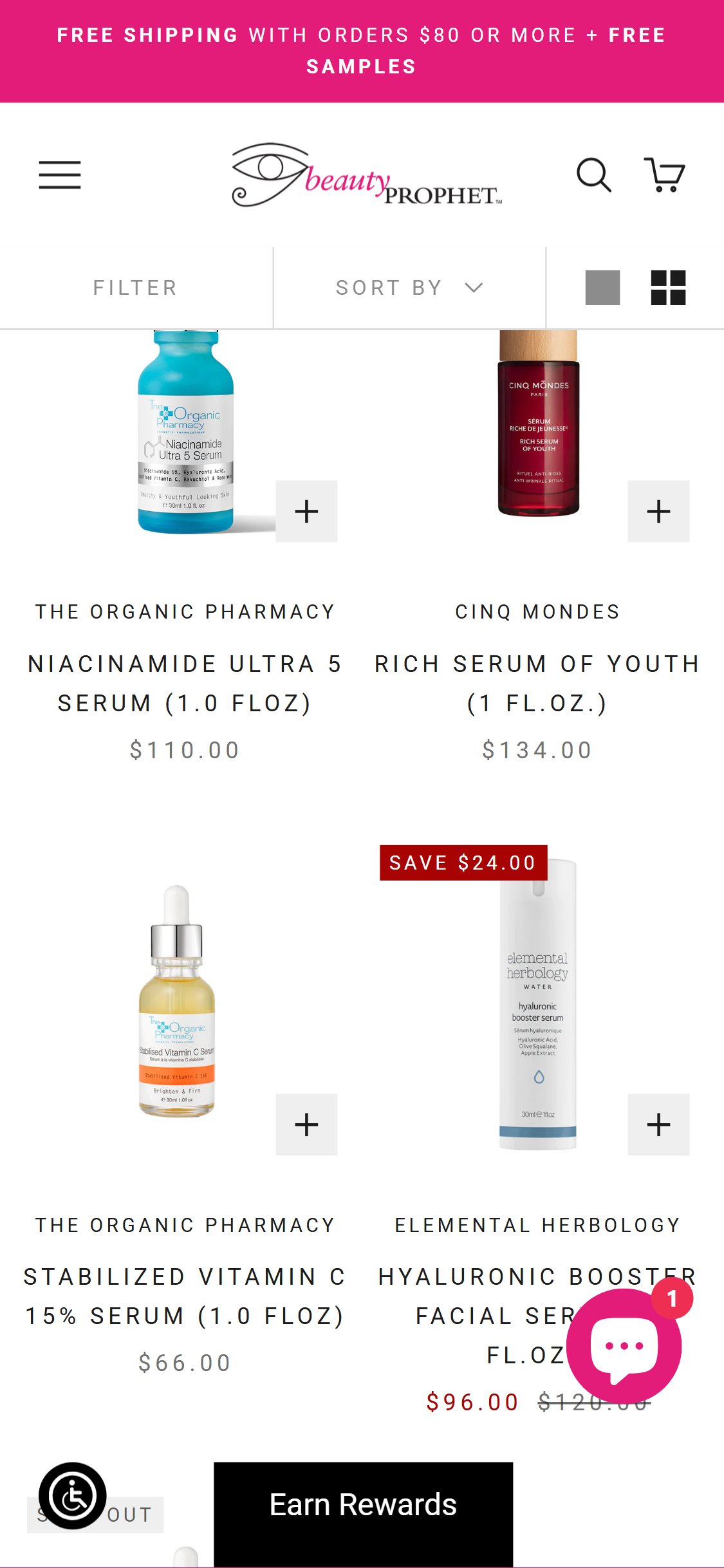
Beauty Prophet — Cards Without Badges
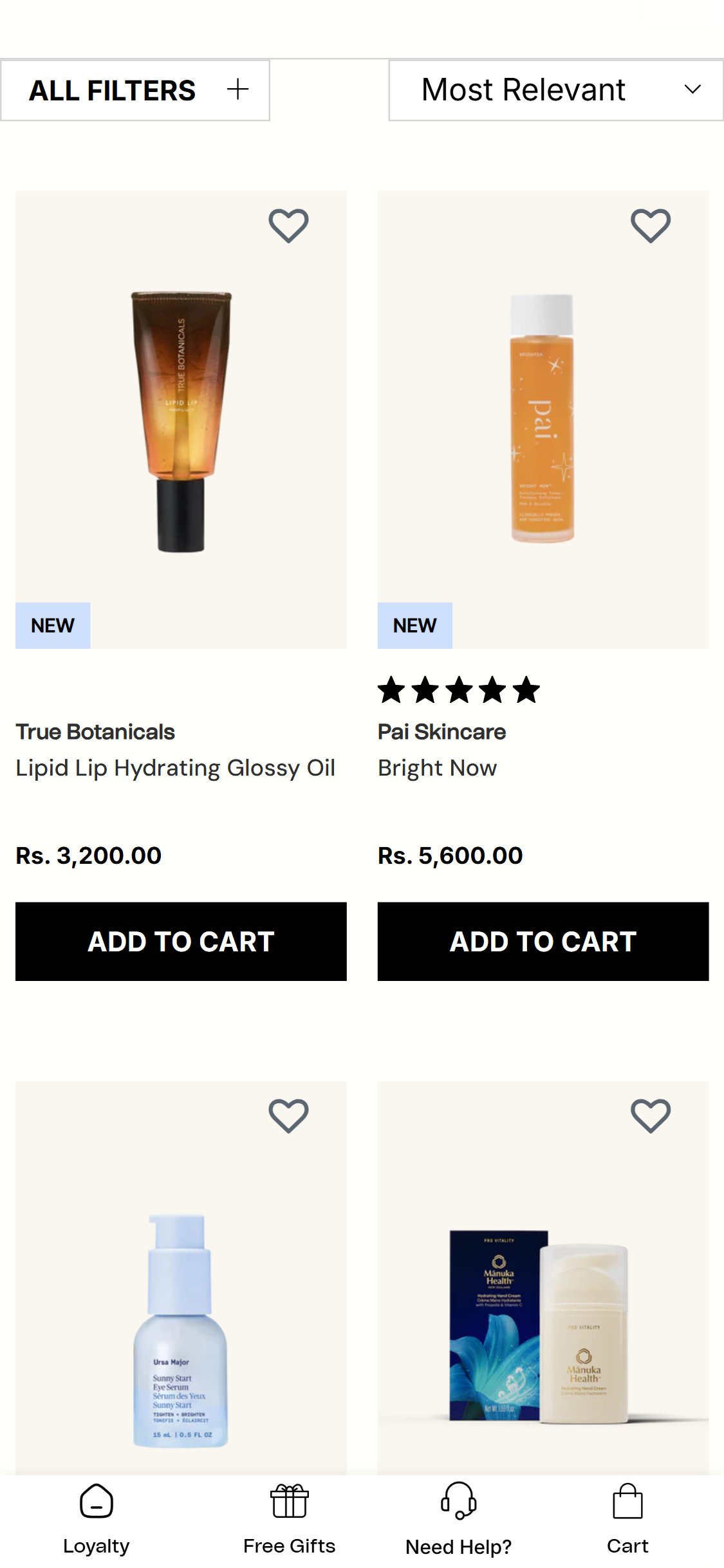
The Detox Market — 'Best Seller' and 'New' Badges on Product Cards
Observations
- Beauty Prophet's collection product cards show only: product image, brand name, product title, and price — no 'Bestseller', 'Editor's Pick', 'New', or popularity badges.
- With 152 products and minimal reviews, shoppers have no visual cues to identify which products are most popular or editorially validated — leading to browse paralysis.
- 5/10 beauty benchmark brands use 'Bestseller' or 'Highly Rated' badges on top products (The Ordinary, mCaffeine, Kiehl's) — these badges direct attention and reduce decision fatigue.
- As a curated beauty retailer, Beauty Prophet's editorial expertise ('We only carry brands with integrity from inception to market') is a key differentiator — 'Editor's Pick' or 'BP Favorite' badges on select products would communicate curation credibility directly on the product card.
Recommendations
- Add 'Bestseller' badges to the top 10 products by units sold, and 'Editor's Pick' badges to 5-8 editorially selected hero products — use Shopify product tags + theme metafields to control badge display.
- Add 'New' badges to products added in the last 30-60 days — signals freshness and encourages return visitors to discover new arrivals.
- Consider a 'Beauty Prophet Approved' custom badge to reinforce the curated positioning — differentiates from generic 'Popular' badging used by mass retailers.
No customer reviews on PDPs costs beauty brands 15-20% of conversions
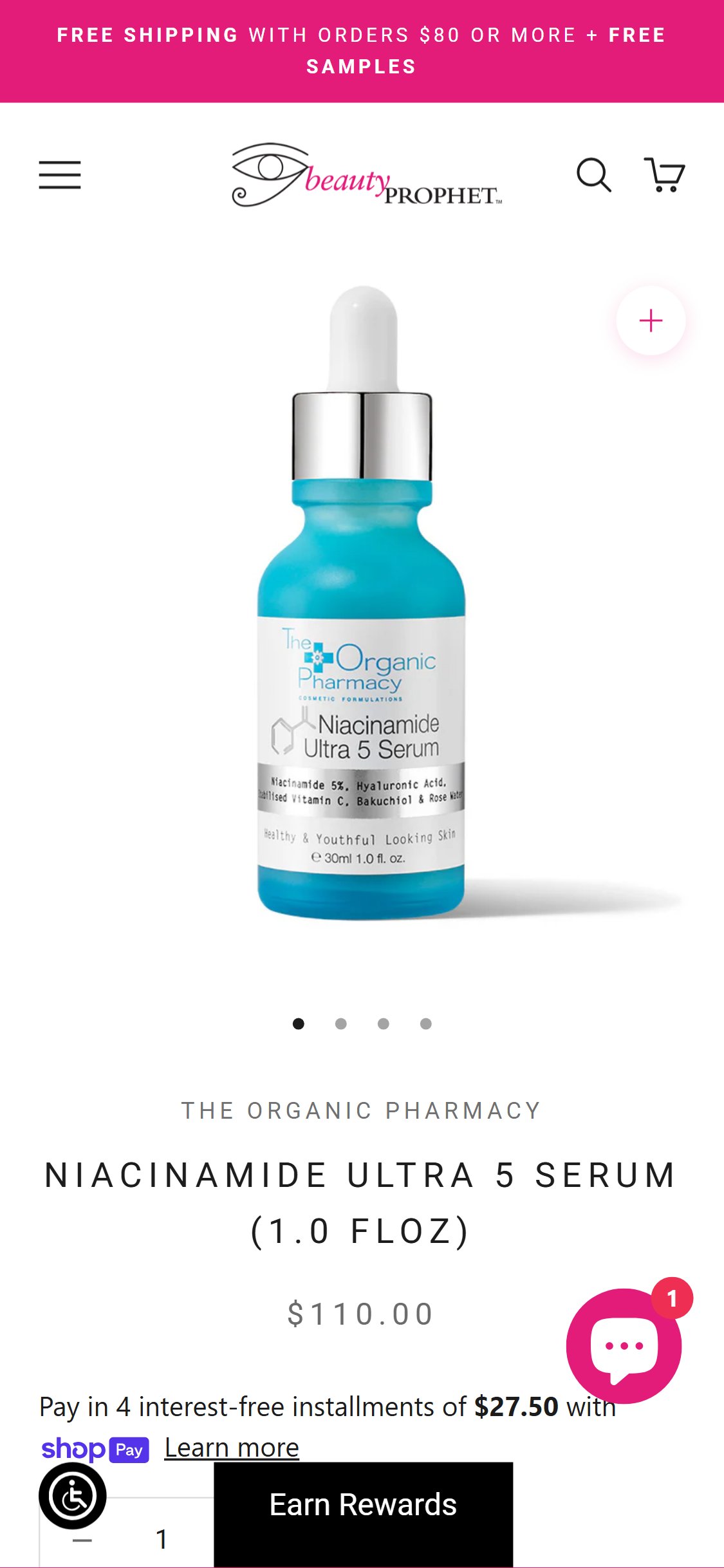
Beauty Prophet — No Reviews

Proposed Implementation — PDP with Star Ratings + Photo Reviews
Observations
- Every product page checked shows zero visible review section — no star rating, review count, or customer comments appear on any PDP despite a review widget indicator present on collection cards.
- Most products display 0 reviews; a handful have 1 review — critically below the beauty industry standard where top brands show 1,000–10,000+ reviews per hero product.
- 10/10 beauty brands in the benchmark (Glossier, Kiehl's, Fenty, The Ordinary, Minimalist) display star rating + review count above the fold on every PDP — this is the single most universal trust signal in beauty.
- Absence of reviews is particularly damaging for a curated multi-brand retailer like Beauty Prophet, where shoppers unfamiliar with carried brands rely entirely on peer reviews to validate the $46–$150+ price points.
Recommendations
- Implement a review platform (Judge.me, Okendo, or Loox) and prioritize collecting reviews via post-purchase email flows — even 5–10 reviews per product dramatically improves conversion.
- Display star rating + review count immediately below the product title, above the ATC button, to place social proof in the highest-attention zone.
- Enable photo reviews to show real results on real skin types — critical for a natural/organic beauty brand where visual proof of efficacy is the primary sales driver.
Trust badges near Add to Cart reduce purchase anxiety — 90% of beauty brands use them
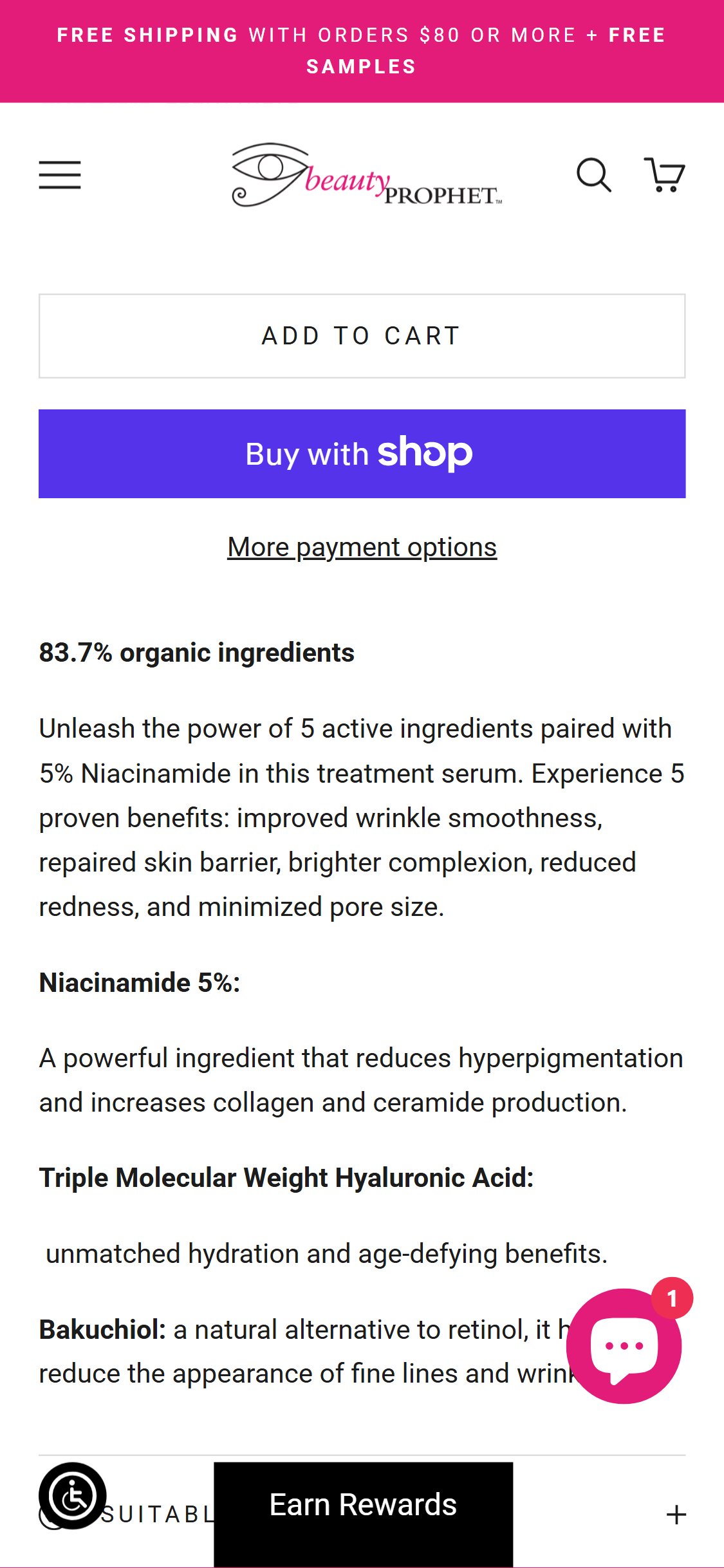
Beauty Prophet — No Trust Badges Near ATC
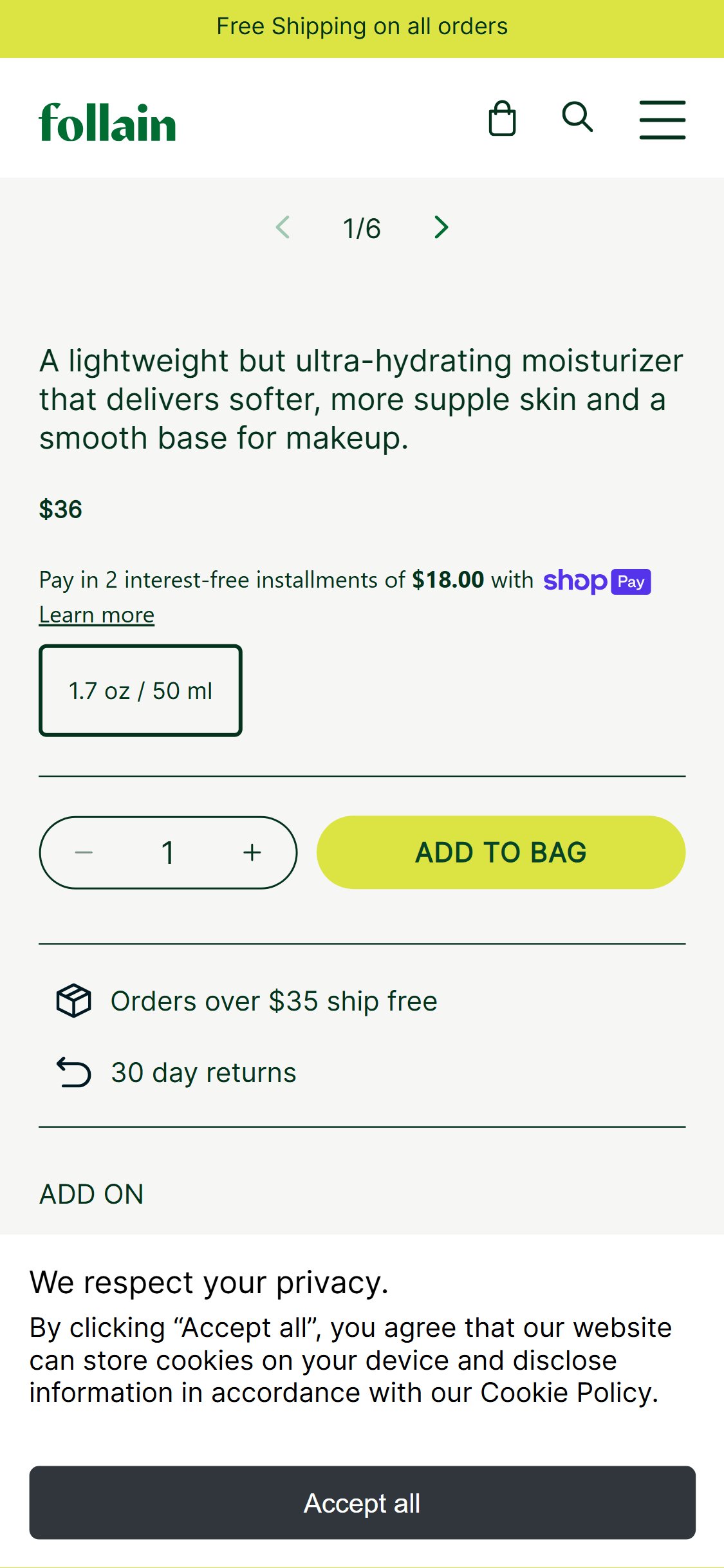
Follain — Trust Badges (Credo Clean, Cruelty-Free, Vegan) near ATC
Observations
- Beauty Prophet's ATC zone contains only: price, Shop Pay installment line, quantity selector, and ATC button — no trust badges or certifications appear near the primary conversion action.
- Trust signals (Free Ground Shipping, Free Samples, 5-Star Customer Service) appear only in the page footer — below the fold and after the decision moment has passed.
- 9/10 benchmark brands display 4-6 trust/claim badges immediately near their ATC button: Vegan, Cruelty-Free, Dermatologist-Tested, Fragrance-Free — specific claims that address purchase hesitation at the moment of decision.
- For products priced $46–$150+ with unfamiliar European brands, formulation transparency (paraben-free, organic %) placed near ATC is a proven conversion lever.
Recommendations
- Add 4-6 trust badge icons in a horizontal strip directly above or below the ATC button: 'Paraben Free', 'Cruelty Free', 'Organic Certified', 'Dermatologist Tested', 'Free Samples Included'.
- Move the free shipping threshold callout ('Free shipping on $80+ orders') from the announcement bar to a position near the ATC button to reinforce the purchase decision.
- Use icon+text badge format (not just text) for visual scanning — shoppers read badges faster than paragraph copy when evaluating products.
A sticky Add-to-Cart bar on mobile PDP can lift conversions 3-5%
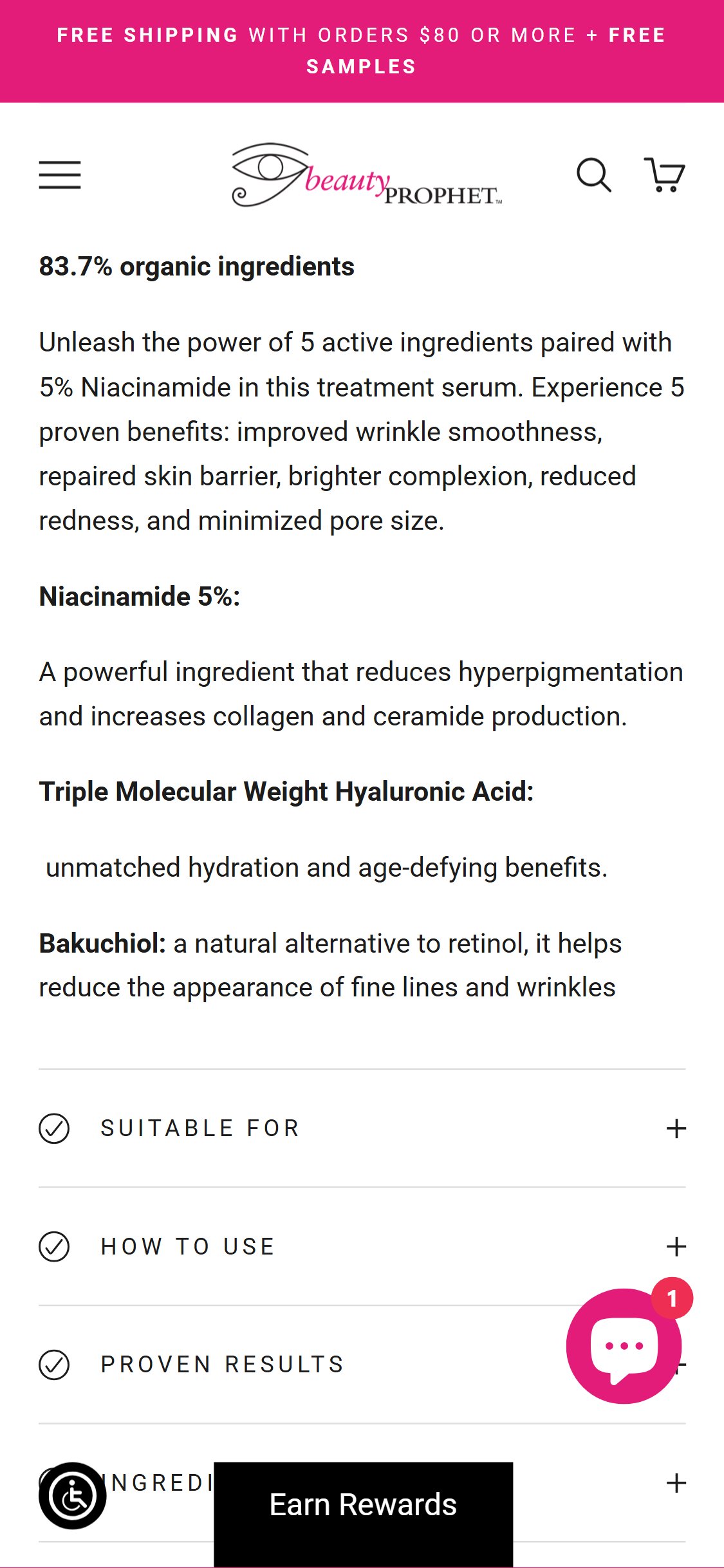
Beauty Prophet — No Sticky ATC

Proposed Implementation — Sticky ATC Bar on Mobile PDP
Observations
- Beauty Prophet's PDPs do not display a sticky ATC bar — once a user scrolls past the product image and ATC button zone, there is no persistent purchase action visible.
- Beauty PDPs are content-rich: ingredient lists, benefit descriptions, and 'proven results' copy require significant scroll — leaving shoppers without a visible conversion path during research.
- 7/10 beauty benchmark brands show a sticky ATC bar (or sticky product header) that persists through PDP scroll on mobile, keeping the purchase action one tap away at all times.
- Given the $46–$150+ price range, shoppers spend more time reading before deciding — a sticky ATC ensures the 'ready to buy' moment is captured wherever it occurs on the page.
Recommendations
- Implement a sticky bottom ATC bar on mobile that appears after the user scrolls past the product image zone — should include product name, price, and ATC button.
- Include a variant selector in the sticky bar if the product has size options (essential for future multi-size offerings).
- Test sticky bar with vs. without product thumbnail to determine which drives higher engagement on mobile.
No cross-sell or routine builder on PDP — a missed AOV opportunity for skincare routines
Feature not present
Beauty Prophet — No Cross-Sell Present
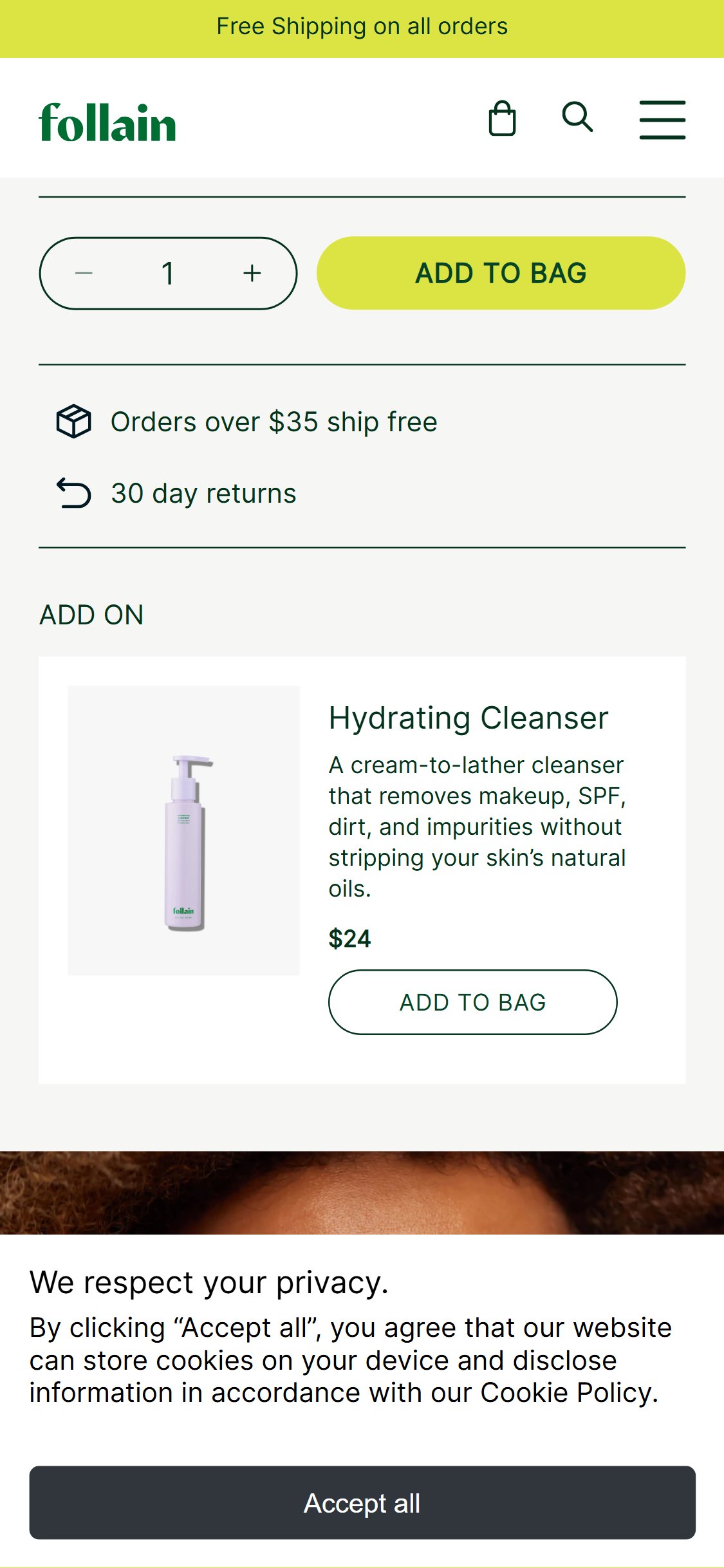
Follain — 'Add On' Routine Cross-sell on PDP
Observations
- No 'You May Also Like', 'Frequently Bought Together', 'Complete Your Routine', or any cross-sell section appears on any Beauty Prophet PDP.
- Natural/spa beauty shoppers don't buy a single product — they build routines (cleanser → serum → moisturizer → eye cream). Beauty Prophet carries all these steps from the same brand families but doesn't guide shoppers to build a routine on PDP.
- 7/10 beauty benchmark brands show cross-sell or routine-builder sections on PDPs — Glossier's routine builder ('Pair with…') is the gold standard, while The Ordinary shows regimen step indicators.
- Average order value (AOV) for beauty routines is 2-3x single product AOV — a routine builder directly translates to revenue per session increases.
Recommendations
- Add a 'Complete Your Routine with [Brand]' cross-sell section on each PDP, curated by brand (e.g., viewing a Cinq Mondes mask → show Cinq Mondes cleanser and serum).
- Frame cross-sell as a routine recommendation, not generic upsell: 'Step 1: Cleanse → Step 2: Treat → Step 3: Moisturize' — this language converts 2-3x better in skincare than 'Customers Also Bought'.
- Implement with Rebuy or LimeSpot for automated recommendation rules, or manually curate 3-product routine bundles for each brand's hero products.
Benefit icon strip on PDP increases perceived value — 70% of beauty brands use visual tags
Beauty Prophet — Text-Only Claims, No Icons
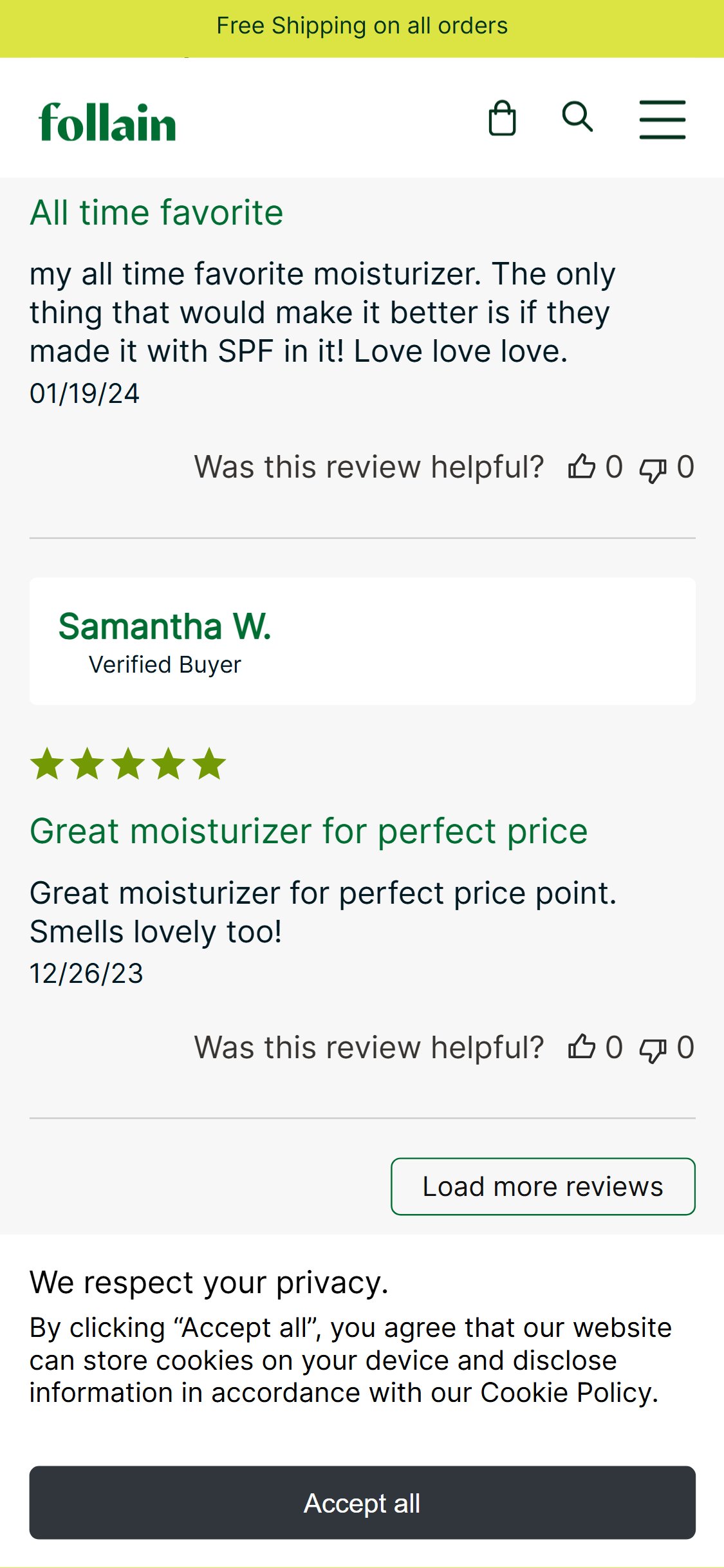
Follain — Benefit Icon Strip (Credo Clean, Sustainable, Cruelty-Free)
Observations
- Beauty Prophet PDPs communicate product benefits through narrative text (e.g., '83.7% organic ingredients') but do not use visual benefit icons or pill tags near the product name or ATC zone.
- Benefit icons (Vegan ✓, Cruelty-Free ✓, Paraben-Free ✓, Dermatologist-Tested ✓) enable fast scanning at 3-5 seconds — the average attention window before a shopper decides to read further.
- 7/10 beauty benchmark brands use benefit icon strips: Fenty uses 5 icons, Minimalist uses checkmark badges with exact specifications (pH: 4.5-5.5), Plum uses 'Plum Promise' icons.
- For a brand built on 'high integrity from inception to market', visual certifications (organic %, cruelty-free, paraben-free) communicate the brand promise at a glance rather than requiring text reading.
Recommendations
- Add a 4-6 icon benefit strip between the product title and ATC button: Organic Certified, Cruelty Free, Paraben Free, Dermatologist Tested, Free from Silicones — align with Beauty Prophet's ingredient integrity positioning.
- Use percentage-backed claims where available ('83.7% organic') as icon labels for maximum specificity — specific > generic in beauty trust signals.
- Ensure icons are consistent across all PDPs using a Shopify metafield system or product tag approach, not hardcoded per page.
Back-in-stock notifications for sold-out products recover lost demand
Feature not present
Beauty Prophet — Feature Not Present

Proposed Implementation — Notify Me When Back in Stock
Observations
- Multiple products on Beauty Prophet are marked 'Sold out' (confirmed on /collections/all and individual PDPs) with no waitlist or back-in-stock notification option.
- Sold-out product pages currently show a disabled 'Sold out' button with no action — converting zero out of the visitors who arrive with genuine purchase intent.
- US beauty shoppers who find their desired product sold out will go to a competitor rather than return and check stock manually — without a notification, this demand is permanently lost.
- A 'Notify Me When Available' email capture on sold-out PDPs doubles as a secondary email list growth mechanism and signals to the brand which products to prioritize for restocking.
Recommendations
- Replace the disabled 'Sold out' button with a 'Notify Me When Back in Stock' email form on all out-of-stock PDPs — use Back in Stock (backinstock.com) or Klaviyo's built-in back-in-stock flow.
- Send the notification within 1 hour of inventory restoration and include a direct link back to the product PDP for maximum recovery rate.
- Use waitlist data as a demand signal for purchasing decisions — products with 20+ waitlist signups should be prioritized for restocking.
Free shipping progress bar in cart drives AOV lift — missing with an $80 threshold
Feature not present
Beauty Prophet — Feature Not Present

Proposed Implementation — Free Shipping Progress Bar in Cart
Observations
- Beauty Prophet's cart page shows 'FREE SHIPPING WITH ORDERS $80 OR MORE' only as a static header text — no dynamic progress bar indicates how close the shopper is to the free shipping threshold.
- A $80 free shipping threshold is achievable for most shoppers but psychologically requires nudging — a progress bar ('You're $22 away from free shipping!') creates tangible momentum toward adding another item.
- 7/10 beauty benchmark brands show a free shipping progress bar in the cart drawer or cart page — turning the threshold from an abstract number into a gamified AOV driver.
- Beauty Prophet's curated range of face serums ($46-$110) makes threshold-nudging particularly effective — a single product upsell or sample promotion to cross the threshold has high conversion probability.
Recommendations
- Add a dynamic free shipping progress bar at the top of the cart page that updates in real-time as items are added ('$22 more for free shipping' → 'You've unlocked free shipping!' as threshold is crossed).
- Pair the progress bar with a cross-sell recommendation ('Add [product] to reach free shipping') for maximum AOV impact.
- Consider testing whether lowering the threshold to $65 or $70 (while adding a premium add-on at the existing $80 level) increases AOV without reducing margin.
Cart with no routine cross-sell loses the beauty brand's highest-AOV opportunity
Feature not present
Beauty Prophet — Feature Not Present
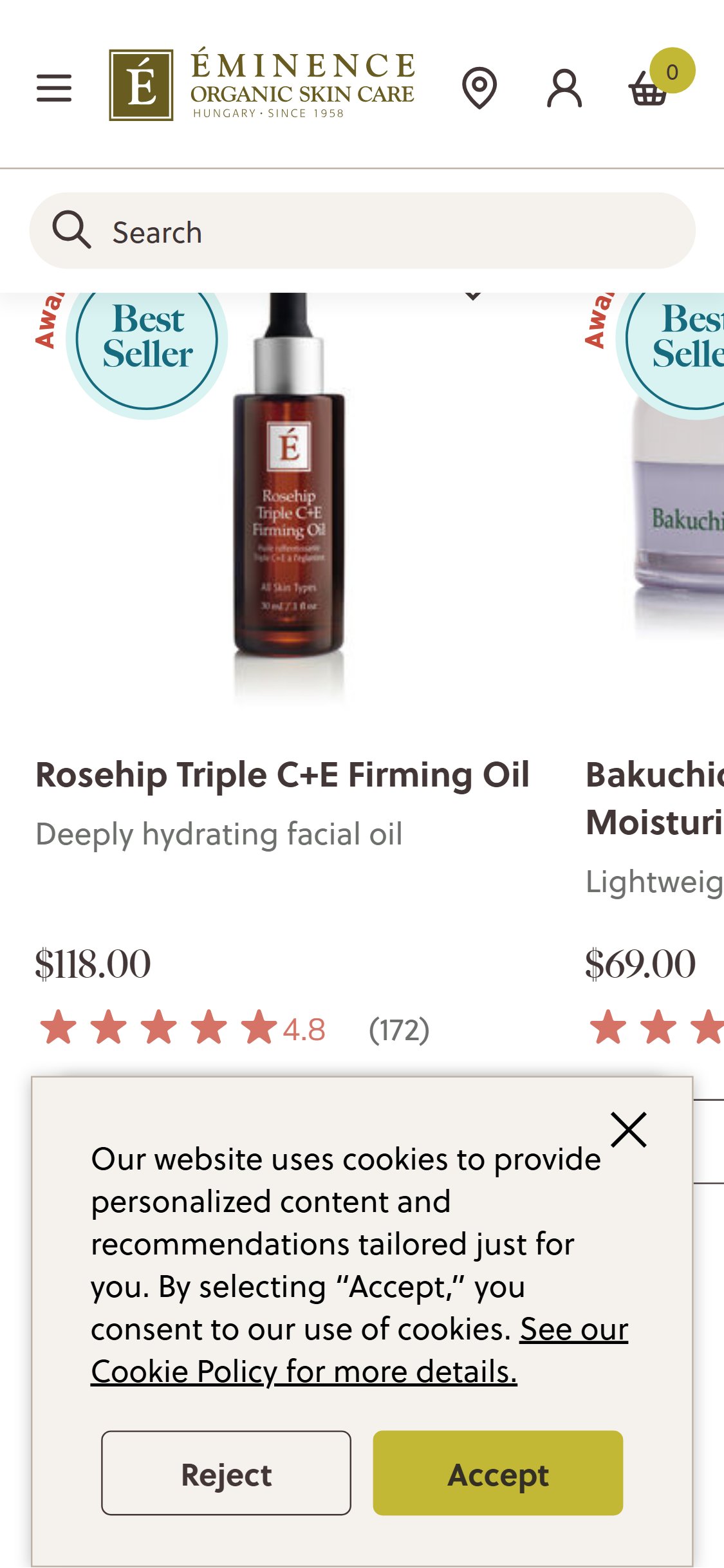
Eminence Organics — 'Shop Best Sellers' Cross-sell in Cart
Observations
- The Beauty Prophet cart page shows no cross-sell, no routine completion suggestions, and no product recommendations — shoppers who add a single item to cart see only that item with no prompts to expand their order.
- Beauty cart cross-sell framed as 'Complete Your Routine' consistently outperforms generic 'You May Also Like' by 2-3x in add-on rate — because it provides a rationale (your routine needs a cleanser) rather than a generic prompt.
- 7/10 beauty benchmark brands show cart cross-sell sections: The Detox Market and Follain both prompt routine completion in the cart experience.
- Given that Beauty Prophet carries all routine steps (cleanser, serum, moisturizer, eye care, body care) from the same brand families, in-cart routine prompting is highly relevant and brand-consistent.
Recommendations
- Add a 'Complete Your Routine' cross-sell section in the cart showing 2-3 complementary products from the same brand as the carted item.
- Frame recommendations by routine step: 'You have a serum — add a cleanser and moisturizer to complete your [Brand] routine'.
- Implement with Rebuy SmartCart or a manual Shopify cart customization; ensure recommendations update dynamically based on cart contents.
Payment trust icons near checkout reduce payment anxiety for first-time buyers
Feature not present
Beauty Prophet — Feature Not Present

Proposed Implementation — Payment Trust Icons Near Checkout
Observations
- Beauty Prophet's cart/checkout CTA area shows payment method icons only in the footer — not near the checkout button where purchase hesitation peaks.
- Payment icons (Visa, Mastercard, Shop Pay, Apple Pay, Google Pay, PayPal) visible near the checkout button signal payment security and option diversity at the exact moment of final decision.
- For a first-time buyer on a smaller beauty retailer (vs. Sephora or Ulta), displaying SSL lock, payment icons, and '100% Secure Checkout' badge near the checkout button reduces abandonment from payment anxiety.
- The cart page currently shows no security signals — all trust elements are in footer, away from the conversion action.
Recommendations
- Add a payment icon strip (Visa, MC, Shop Pay, Apple Pay, Google Pay, PayPal, Amex) immediately below the checkout button in the cart.
- Add a single line of copy: '100% Secure Checkout — Your data is always protected' with a lock icon above or below the payment icons.
- Consider adding a '30-Day Return' or 'Satisfaction Guaranteed' badge near checkout to address post-purchase anxiety at the moment of purchase.
03
App Ecosystem
What's installed vs what's missing from best-in-class Beauty & Personal Care stores
Present (4)
Shop Pay Installments
Buy Now Pay Later
Loyalty/Rewards Program
Retention
Skin Quiz
Personalization
Review Widget (minimal)
Social Proof
Missing (8)
Email Marketing / Popup (Klaviyo) Recommended
Email Capture
📈
Robust Review Platform (Judge.me / Okendo / Loox) Recommended
Social Proof
📈
Live Chat / Support Widget (Gorgias / Tidio) Recommended
Customer Support
📈
Cross-sell / Upsell App (Rebuy / LimeSpot) Recommended
Revenue Optimization
📈
Free Shipping Progress Bar Recommended
Cart Optimization
📈
Back-in-Stock / Waitlist (Back in Stock / Klaviyo) Recommended
Inventory Recovery
📈
Subscription / Auto-Replenish (Recharge / Bold) Recommended
Retention
📈
UGC / Instagram Feed (Instafeed / Taggbox) Recommended
Social Proof
📈
App Stack Assessment
4 apps detected, 8 critical gaps identified
Confidential — Prepared for Beauty Prophet by Growisto | May 2026